

Story 24 · Patterns 5+
Bani and the Pattern Train
≈ 8 min read
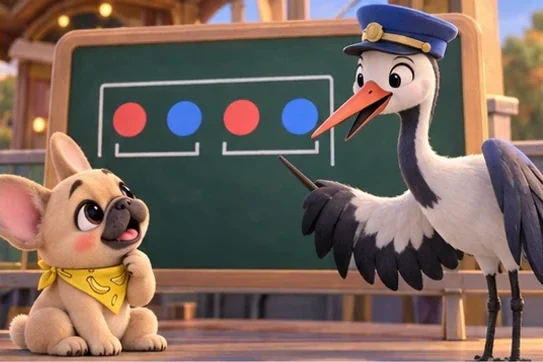
At Pattern Station, a train refused to move. The first carriage was red, the second blue, the third red again, and the fourth place was empty. The sign flashed: red—blue—red—? “Green,” Bani suggested. “It’s pretty.” Conductor Crane tilted his long beak. “Pretty is a fine reason for choosing a scarf, but not a timetable.” Bani looked again and coupled a blue carriage instead. The sign gave a cheerful ding, and the engine puffed a cloud shaped like a check mark. “I think this train wants us to find the rule, not just a color we like,” Bani said.
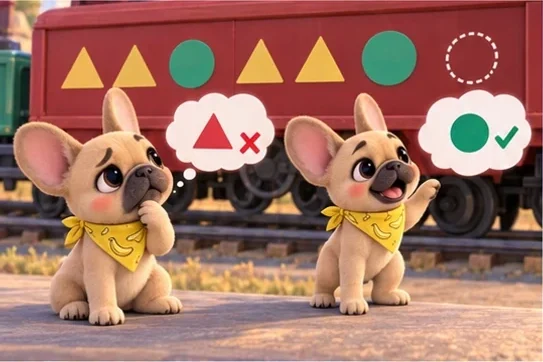
In the next carriage lay cards: triangle, triangle, circle; triangle, triangle, circle; triangle… Bani looked only at the last card and grabbed a square. The carriage made a disappointed booop and the door stayed shut. So Bani said the whole sequence aloud and clapped after each complete chunk: “two triangles and a circle—pause—two triangles and a circle.” The missing cards were another triangle and then a circle. The door slid open. Sometimes, he realized, a pattern becomes easier to see only after you find the small block that keeps coming back.
The music carriage had no pictures at all—just a drum and a wooden floor. A speaker played clap-clap-stomp, clap-clap-stomp, clap-clap… Bani spent a moment looking for something to draw, then stamped his foot. The train rolled forward. Crane tried another: soft-loud-loud, soft-loud-loud. “So patterns can be invisible?” Bani asked. “And inedible,” Crane added, because Bani was examining the pattern on a biscuit. Bani laughed and began noticing repeats in the wheel sounds, the signal lamps, and even the windows of houses outside.

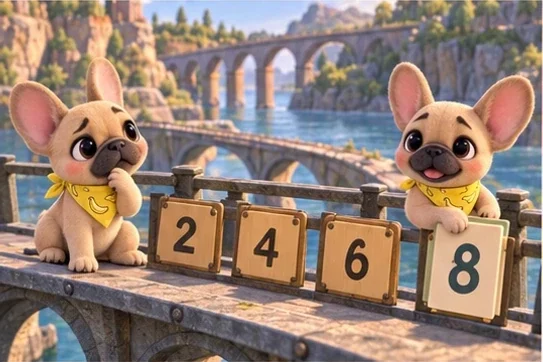
Before the bridge stood number posts: 2, 4, 6, ?, 10. Bani quickly said eight, but Crane did not signal the driver. “How do you know?” Bani almost said “because I know,” then noticed the bridge was still waiting. Each step added two. He checked the rule one step farther: eight really did lead to ten. The bridge lit in stripes and played a tiny fanfare. Bani discovered that an answer became stronger when he could explain how it worked—and the bridge, apparently, was a big fan of explanations.
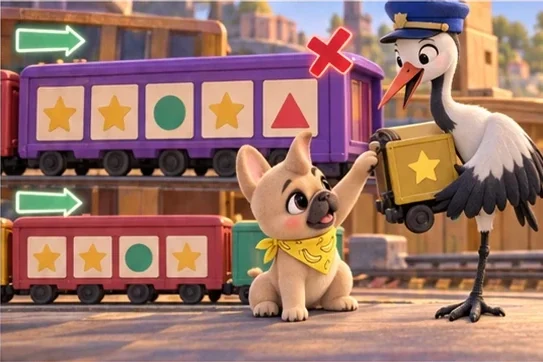
Beyond the bridge, the False Arrow tried to trick them with a sequence that was nearly right: star, moon, star, moon, star, sun. “See? A perfect pattern!” it announced. Bani almost agreed, but the sixth symbol broke the rhythm. He replaced the sun with a moon. “What if the rule was supposed to change?” the arrow asked slyly. “Then we would need a clue that it changed,” Bani said. Crane lifted one approving wing. A pattern was useful not only for guessing what came next. It also helped Bani spot the exact place where something stopped following the rule.
In the final tunnel, the lights went out and a message appeared: MAKE A PATTERN OTHERS CAN CONTINUE. Bani first arranged seven favorite colors in random order. Nothing happened. Then he chose three—yellow, mint, coral—and repeated them twice. Crane covered one tile with his hat. The passengers easily named the missing color. “So the rule makes sense to someone besides me,” Bani said. The tunnel lit in the same three colors, as if the whole train had pulled on a festive striped scarf.
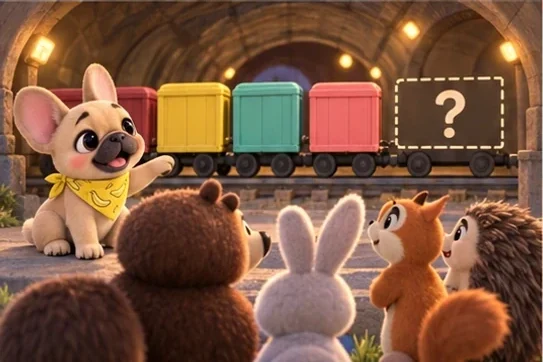
When they came out of the tunnel, the world seemed full of patterns. Telephone poles alternated tall-short-tall-short. Station windows went round-round-square. The wheels beat a steady rhythm. Even Crane did the same thing before every departure: whistle, lift one wing, take two steps back. “Are you a pattern too?” Bani asked. “Only before lunch,” the conductor replied seriously. Bani laughed so hard he almost missed his stop.

At sunset the train rolled onto the main platform exactly on time. Crane punched a ticket for Bani with the pattern circle-square-circle. “If a sequence feels like a riddle, find what repeats, name the rule, and test it one more step.” Bani put the ticket in his pocket, then decided that sounded too much like instructions. He preferred his own version: “A pattern is the world quietly saying, I’ve done this before—can you guess what I might do next?” From then on he saw patterns where he had once seen only pretty things.