
Story 37 · Fairness and exchange 5+
Bani and the Orchard of Fair Baskets
≈ 8 min read
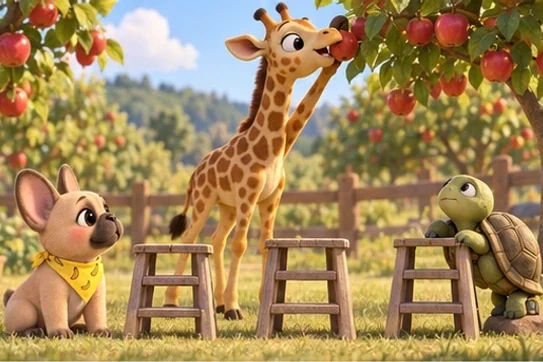
In the Orchard of Fair Baskets grew apples of every size: tiny golden ones, round red ones, and enormous green apples that barely fit between two paws. For harvest day, Bani prepared identical little ladders. “Perfectly fair! Everyone gets exactly the same thing,” he announced. Giraffe could reach the high branches without a ladder at all. Turtle set hers down, looked at the first step, and sighed. It was almost impossible for her to climb. “But the ladders are identical,” Bani said. Llama, the orchard keeper, asked, “Did everyone get the same chance to take part?” Bani looked at Turtle and realized that was a very different question.
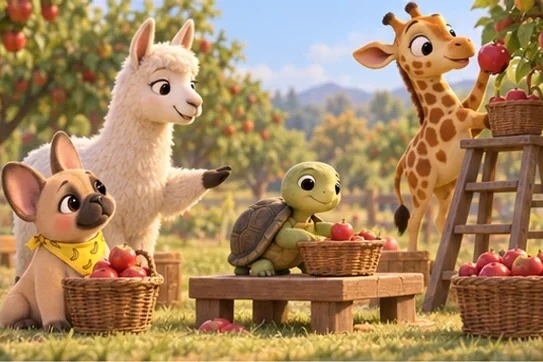
They began not with tools but with the shared goal: gather the crop safely and give everyone a useful role. Giraffe picked the high apples. Turtle used a low stable platform and sorted the fruit. Bani carried baskets, and Squirrel checked branches inside the tree. “Is it still fair if the work is different?” Bani asked. Llama nodded. “Fair does not always mean copying the same action. The important thing is that the rules are clear and everyone has a real way to contribute.” By lunchtime the team looked less like identical workers and more like a puzzle whose different pieces fit together.
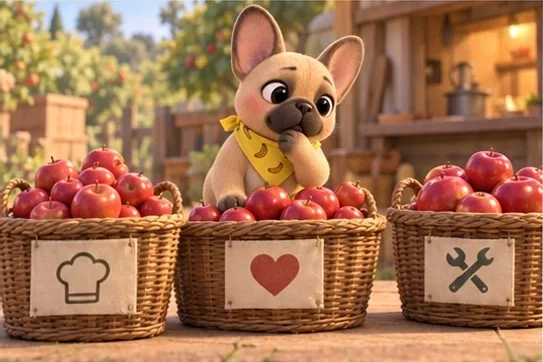
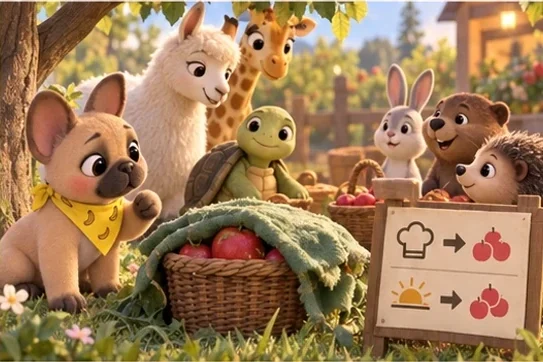
When the baskets were full, Bani suggested dividing all apples equally among the workers. Llama showed him the harvest list. Part had already been promised to the community kitchen, part to a family whose supplies were low, and the rest really did belong to the team. “If we make equal piles from everything, we break the agreements we made before harvest.” Bani frowned. The rule “same for everyone” had been easier. But the group already knew why each portion existed. They separated the apples by purpose first, then divided what was meant for the workers.
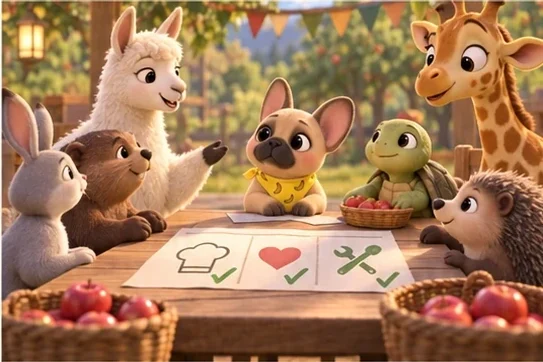
Two worker baskets still looked unfair. One held eight small apples, the other only five large ones. “Eight is more than five,” Bani said. Turtle brought out scales. Five large apples weighed almost the same as eight small ones. Then they compared the quality too. Bani saw that one number rarely told the whole story. Number of pieces, size, and weight were different ways of comparing. “So first we decide what kind of fairness matters here?” he asked. Llama smiled. “Now the orchard is beginning to talk to you.”
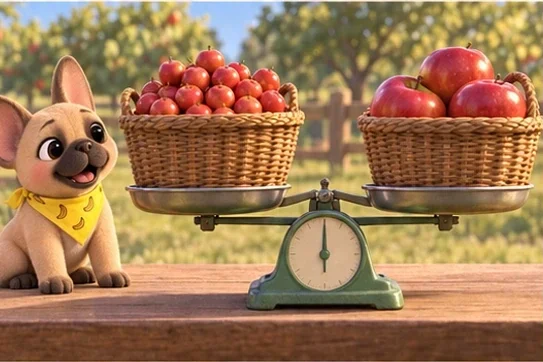
Just as they finished, someone found a forgotten basket behind the shed. Bani was closest and could easily have chosen the prettiest apple first. Instead he called the team. “We have a new part of the harvest. What do our rules say?” They decided to add some to the community kitchen and save some for the helpers arriving tomorrow. A young rabbit asked why they did not divide everything again from the beginning. Llama explained that fairness did not have to erase every agreement each time something new appeared. What mattered was deciding openly how the existing rule applied to the new situation.
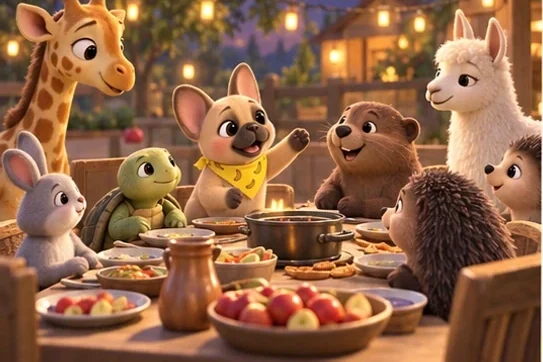
At dinner Bani noticed another detail. Turtle ate less, Giraffe ate more, and one helper did not want apples at all and chose bread. “If everyone gets the same plate, is that fair?” he asked. Llama suggested not turning supper into an examination. “Sometimes you can simply ask what works for people, as long as it fits the shared agreement.” Bani stopped placing portions in front of everyone without asking. There was less waste, and nobody sat in front of an enormous pile of food only because “everyone gets the same.”
After supper the team talked about the next harvest. Turtle suggested several platforms at different heights. Squirrel wanted baskets labeled in advance for the kitchen and workers. Bani suggested keeping the scales nearby instead of arguing about apple size by sight. Nobody declared their idea the only correct one. They chose changes that made the rules clearer and participation easier. Bani looked at the orchard: similar trees grew different apples, different helpers did different work, yet the shared result was good. Fairness felt less like a formula and more like a conversation everyone could explain.
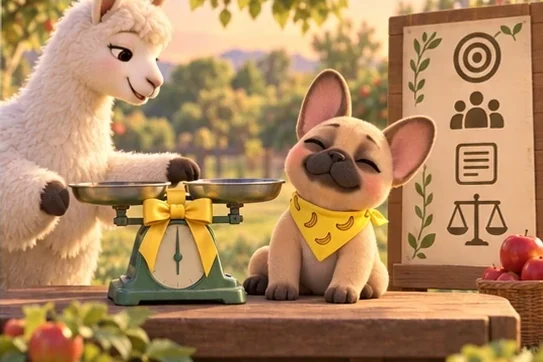
Llama gave Bani a small pair of scales. On one pan was a picture of “the same.” On the other, “a chance to take part.” “They will not balance themselves every time,” she said. “You will have to think.” Bani sighed theatrically. “Thinking again.” But he liked the scales. At home he served pretend tea to his toys and nearly gave everyone identical pieces of biscuit. Then he noticed that the toy elephant was “very hungry” while the plush mouse “wanted half.” Bani laughed and asked each one. It was only a game, but even in the game, equal and fair no longer meant exactly the same thing.