
Story 25 · Parts and the Whole 6+
Bani and the Bakery of Equal Pieces
≈ 8 min read
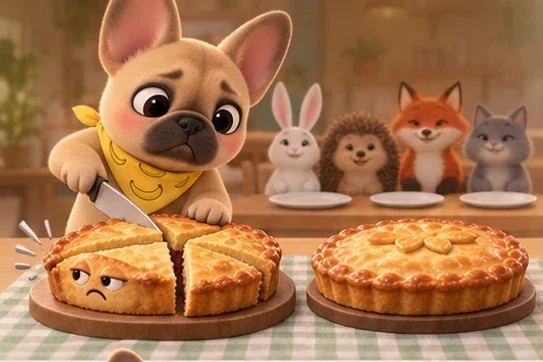
The Bakery of Ringing Pies was getting ready for a party. Vanilla drifted all the way into the street, clouds of frosting cooled on the windowsill, and Baker Capybara rolled dough with a pin almost as long as Bani. Two identical berry pies waited for four guests. “I know how to share!” Bani announced and cut the first pie into four pieces: one enormous, two medium, and one so tiny it held exactly one blueberry. The pie gave an unhappy clang-bong. “Did I hurt its feelings?” Bani asked. “It’s simply very sensitive to unfair portions,” Capybara said.
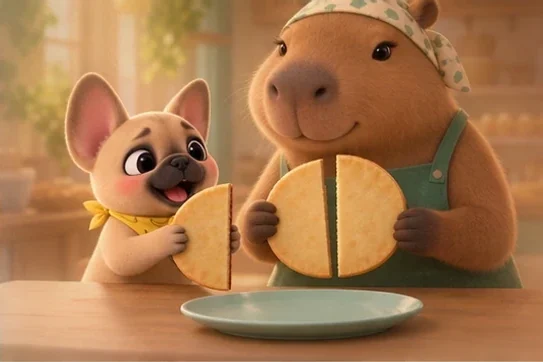
The baker took out a wooden circle and folded it in half. The two pieces matched exactly. “When one whole is divided into two equal parts, each part is a half.” Bani placed one half over the other to check. Then he tried cutting two “halves” by eye; one came out thicker. The pie grumbled again. Bani moved the cut to the middle, and this time it gave a clean ding. “So the pie knows mathematics?” “The pie knows ringing. You’re the one learning mathematics.” Bani liked that answer much better.
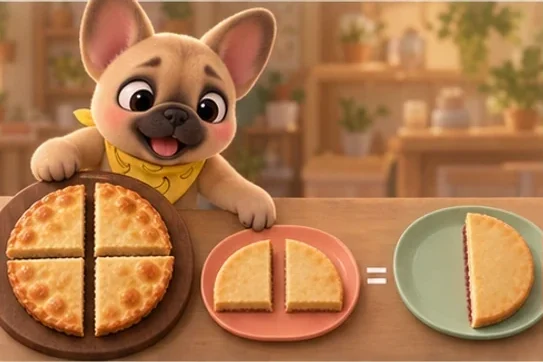
Bani divided another wooden circle in half, then each half in half again. Four equal pieces appeared. Capybara called them quarters. Bani placed two quarters together and covered them with one half—they took up the same amount of space. “Two quarters can make one half!” he cried. “As long as we are talking about the same whole,” Capybara added. Bani made a berry puzzle, building a half from two differently colored quarters. The guests later argued for a very long time about whether raspberry mathematics or blueberry mathematics tasted better.
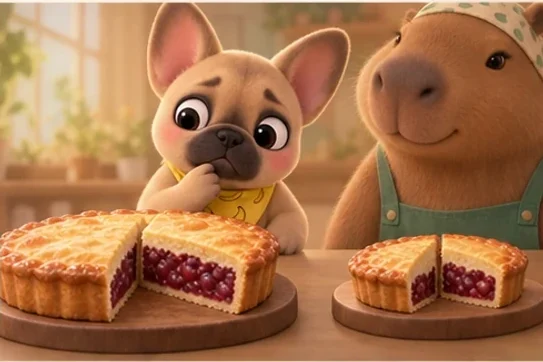
On the next table sat two pies: one large party pie and one small individual pie. Bani cut half of each and stared. The pieces were very different sizes. “But they are both halves!” Capybara set them side by side. “A fraction tells you how many equal parts the whole was divided into—but it also depends on which whole you started with.” Bani looked from the large pie to the small one. “So half the moon and half a biscuit would not be the same amount?” Capybara laughed. “Especially if you plan to eat half the moon.”
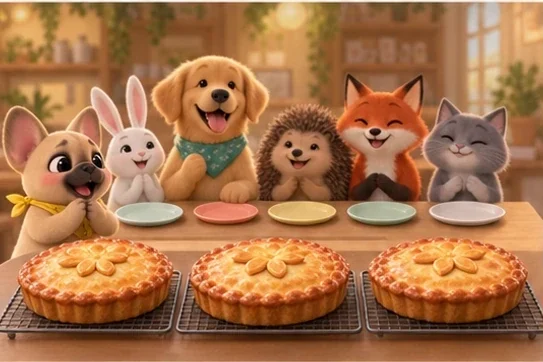
Then a fifth guest rushed through the door, a young Badger carrying a bunch of mint. The table gained one smile and lost one easy plan. Bani briefly considered hiding the fifth plate under a napkin, as if mathematics might not notice it. Capybara raised one eyebrow. “The situation changed, so the plan changes too.” They baked another small pie and worked out equal portions again. Bani learned that fair sharing did not begin with a beautiful number on paper. It began with noticing who was actually sitting at the table.
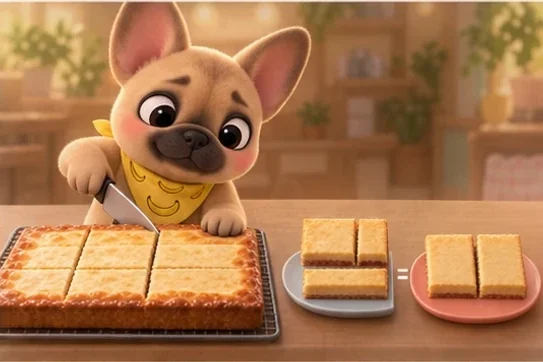
The last pie came out rectangular. Bani frowned. “How can we make quarters if the pieces aren’t round?” Capybara asked him to divide the rectangle in two different ways. One method made four strips; another made four smaller rectangles. They used paper templates to check that the areas matched even though the shapes looked different. The pie rang approvingly. “So equal pieces don’t have to look exactly alike?” “Their shape can differ. What matters is that they are equal parts of the whole.” Bani decided this was excellent news for bakers whose cuts were not always beautifully symmetrical.
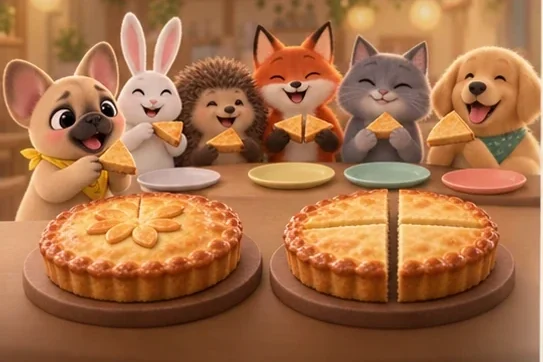
At serving time Capybara turned everything into a game. “Build a whole from pieces.” One plate held two halves, another four quarters, and a third one half plus two quarters. Bani realized all three could add up to one whole pie. Then he made a half from two quarters and set aside a single quarter for a guest who wanted only a taste. The bakery rang like a music box. Even the crumbs on the table seemed to be arranging themselves in careful groups, although Bani suspected that part was only his imagination.
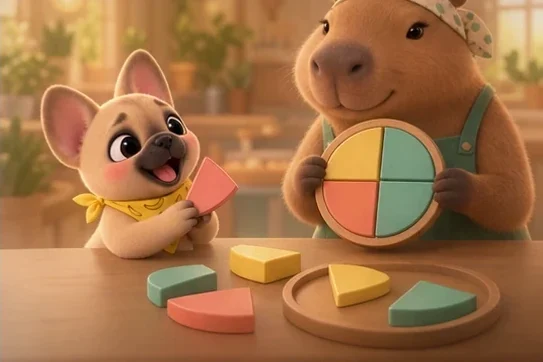
Capybara gave Bani a wooden circle made of four removable pieces. On the back were the words: A PART ALWAYS REMEMBERS ITS WHOLE. At home Bani tried explaining everything to a teddy bear. The bear said nothing, so Bani assumed it understood perfectly. “A half is one of two equal parts. A quarter is one of four. And if the wholes are different, the pieces can be different too.” He thought for a moment and added, “Also, if a fifth guest arrives, don’t hide the plate. Bake another pie.” The teddy bear seemed to approve of that rule most of all.